Sunday, 27 August 2017

Bicester Wetland Reserve: dawn and dusk

I have made a few early morning and evening visits to Bicester Wetland Reserve in the past month.  It is a great time to visit, especially in the morning when the light is behind you, but evening is good too, with birds becoming more active towards dusk.  The reserve is  "key holder only" site because it sits next to a Thames Water treatment works and within part of the security set-up.  This means you need to join the BOS first, then get an induction from the voluntary warden Alan Peters, before being entrusted with a key.  It is well worth it, especially if you live close by and can call in regularly.

Green Sandpipers have been ever present all month, with at least five birds normally feeding around the main scrape that is overlooked by the first hide.  They have a wonderful call that echoes across the reserve, often given when they take flight and chase each other around the pool.  A few Snipe have joined them in the past few days, with three this morning -  generally keeping a low profile, half hidden on a grassy bank, occasionally wading out into the mud.

Two Green Sandpipers
I have also been treated to some great views of Roe Deer recently.  Earlier in the week I saw a very fine looking Roe Deer buck, sitting on the recently cut grassy bank beside the pools.
Roe Deer buck
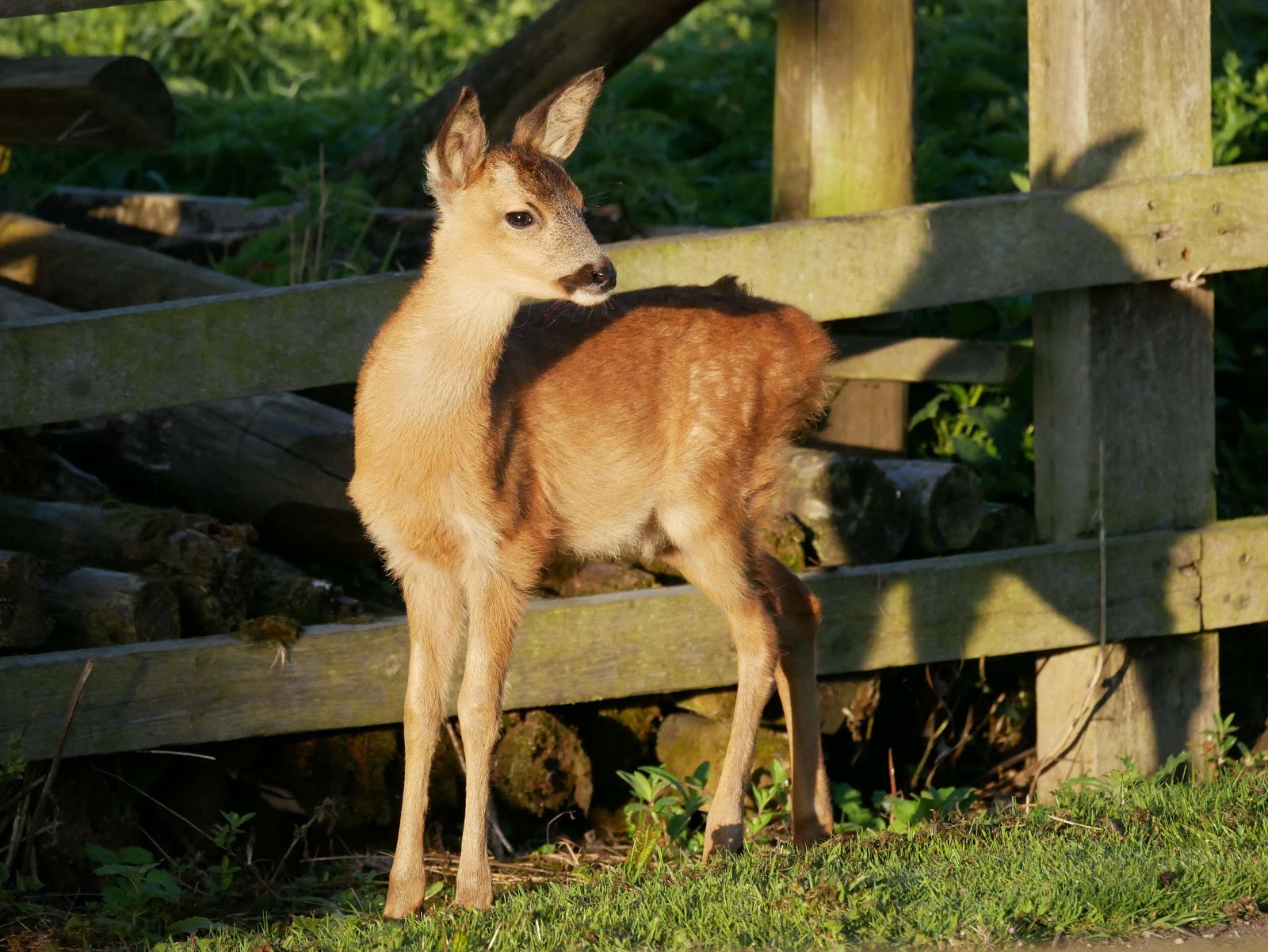
This morning the doe and her kid walked along the entrance road, just below the hide, giving me some great views.  The hide really works a treat in situations like this.

Roe Deer - doe andkid

Roe Deer kid
Roe Deer doe portrait
You often have the reserve to yourself, which is helpful when you get the chance to gradually creep up on a feeding bird like this juvenile Goldfinch, which was much too happy feeding on these thistle seeds to notice my ever advancing telephoto lens....
Juvenile Goldfinch
Another nice reward for my recent evening visit was seeing a juvenile Water Rail emerge from the vegetation that fringes the pool, just as dusk was gathering.  This is the first year that Water Rails have been proven to breed here and I think this was only the second sighting of the juvenile so far.

To finish off this post here are two recent images taken at Grimsbury Reservoir:

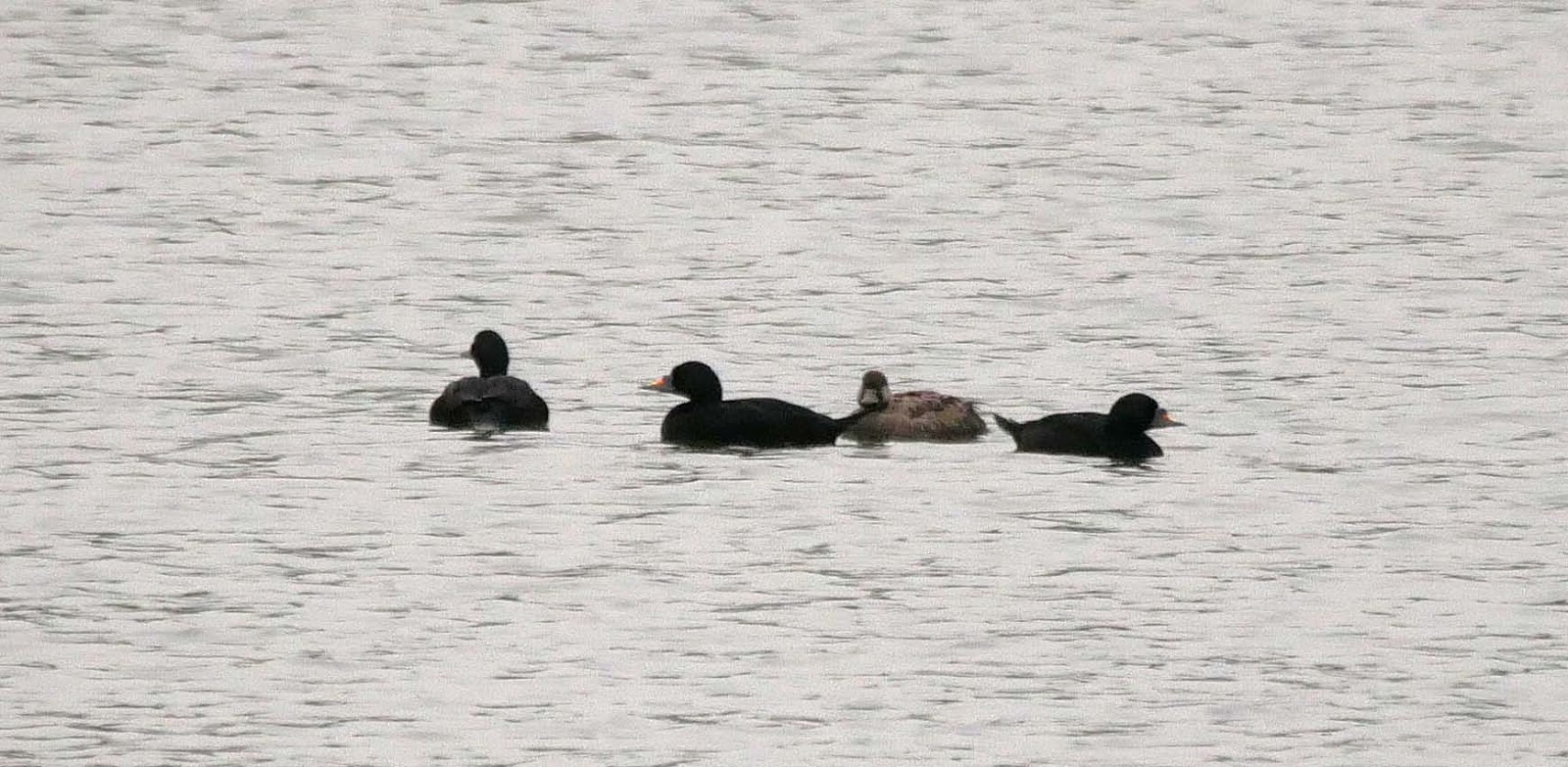
This flock of four Common Scoters found by John Friendship-Taylor earlier in the week.  They stayed just a couple of hours or so, just long enough for a few locals to catch up with them.  This was a new bird for me in the BOS area and certainly the highlight of August birding in the local area...so far.
Common Scoter - three drakes and a female
This Robin is a juvenile bird moulting from spotty juvenile feathers into the full "red breast".
juvenile Robin (spotty juvenile feather remain on the head)


Thursday, 27 July 2017

Bicester Wetland Reserve: Mediterrannean Gull + Oxford Swift Tower: voting underway!

Last Sunday evening I made a trip down the M40 to spend a couple of hours watching Green Sandpipers and seeing what else was about at the Bicester Wetland Reserve.  It was nice to have the place to myself and I spent quite a bit of time watching and sketching a couple of the sandpipers from the first raised hide.  I decided to save my flask of tea for the new hide the overlooks Cattle Bridge Pool.  I settled into the new hide, poured a cuppa and started looking at the birds on the pool - then suddenly realised one of the small group of Black-headed Gulls was distinctly different - a juvenile Mediterranean Gull.  It was busy feeding with the other gulls, constantly on the move, occasionally stopping to preen and take a short flight.  They are still pretty scarce birds in our area, although their UK breeding population is increasing quite rapidly and breeding has now been recorded in Northamptonshire.  Turned out this was the first record for the reserve and a nice addition to the steadily growing list.
Juvenile Mediterranean Gull
with adult Black-headed Gull
Juvenile Mediterranean Gull
Oxford Swift City - please have a look at the three original designs shortlisted and place your vote:

 
This male linnet looked tiny perched on one of the benches at Grimsbury Reservoir last Saturday!
Finally, this is a nature blog and should cover much more than birds.  I couldn't help stop and admire the fine display of  "Chicken of the woods" beside the path through Grimsbury Woodland reserve at the weekend, an amazing bright orange and yellow.
Chicken of the woods - Laetiporus sulphureus
 

Sunday, 16 July 2017

Cattle Egrets breeding on two RSPB reserves this year

Remember those Cattle Egrets that were discovered near Caulcott during the BOS short day count back in January?  They were part of a significant influx that culminated in the second and third records of successful breeding in England.  The first to be "made public", back in May, were a pair at RSPB Burton Mere Wetland.  
Two of the Banburyshire Cattle Egrets, January 2017

Now, it has also been reported that five pairs have also bred at Ham Wall RSPB reserve in Somerset, raising at least nine young.  With a small colony rapidly established - at a site with several other heron species - maybe they can become a more permanent fixture as a UK breeding bird.  If they do, it may be just a matter of time before they spread northwards and start breeding somewhere in our area.

Cattle Egrets have a very wide distribution around the world and can provide a great spectacle, for example when they gather in large flocks before roosting in a favoured clump of trees:
Cattle Egrets  - Daintree River, Queensland, August 2016

Sunday, 18 June 2017

Rushbeds Wood and BBS: Silver-washed Fritillaries and disappearing Tree Sparrows

I have a bit of catching up to do on the blog front, so apologies for recent inactivity! 
Yesterday morning I made my second and final BTO Breeding Bird Survey visit to my 1km2 survey site near Moreton Pinkney in south Northamptonshire.  This is the eleventh year running I have surveyed this area and I have now seen 70 species in total - normally I record about 45 species each year (but nothing new this year, so getting harder to add new birds!).  For most of the common species the numbers are quite consistent, the main change is that Tree Sparrow has gone from really quite common - 23 in 2007 and 14 in 2010 - to none at all either last year or this year.  The species showing upward trends have been Goldcrest, Raven (now breeds very close to the survey square) and Buzzard.  Some of the scarcer birds seen over the years have included Barn Owl, Willow Tit, Hobby, Cuckoo and Kingfisher.  I would definitely recommend participating - the BTO website enables easy data entry and you can generate really useful summary reports from your own sightings.  You are also making a significant contribution to the national scheme that is so vital for monitoring our birds.

Later in the morning, a trip down to Rushbeds Wood nature reserve in the Bernwood Forest area south of Bicester was rewarded with some nice butterfly sightings and some stunning flower meadows.  This was my first visit and I was really impressed with the woodland and equally, the adjoining meadows of Lapland Farm, all managed by BBOWT.   I had hoped to find Black Hairstreaks, but didn't manage to connect despite scanning some excellent looking habitat, however I did manage to find several Silver-washed Fritillaries and a couple of White Admirals.
Silver-washed Fritillary
Silver-washed Fritillary nectaring on bramble
mating pair of fritillaries
Lapland Farm meadow, full of flowers and butterflies - in particular, numerous Meadow Brown and Marbled White
Flowers included Dropwort, Great Burnet and Common Spotted Orchid
Black-tailed Skimmer
Some good news for our local meadows from the Save Gavray Meadows campaign group.  Their tireless work to defend a cluster of meadows in Bicester from housing development achieved a notable success with the refusal by Cherwell District Council Planning Committee of the latest planning application from the developer, Gallagher.  However, there will be an appeal and no doubt this campaign will have to continue for some time to come.

Last week, on Wednesday, I continued my RSPB-organised wader survey in the Middle Cherwell Valley near Somerton (my third visit of the season).  Curlew continue to frequent the floodplain meadows in this area; on this visit one adult was feeding in a recently cut silage field.

This stretch of the Cherwell Valley is also good for farmland wildlife and is rewarding to visit year-round.  Common Poppies were particularly showy this time, with swathes of scarlet running through a couple of fields, especially near the margins.  Yellow Wagtails were gathering food from a large pile of manure, and Yellowhammers were singing from the tall hedgerows
Early morning view across the Cherwell Valley with dew-covered crops
Common Poppy